How To Stabilise Driveways and Roads on Rural Properties
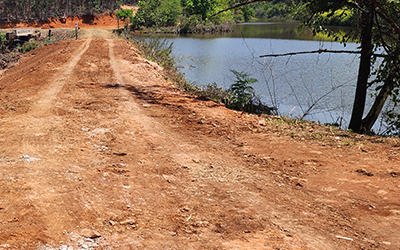
A farm road that turns into a mud channel every rainy season is not bad luck or something that you just have to live with.
It is a drainage problem wearing a disguise, and most farm owners spend years grading the same stretch of dirt road, hoping to fix the issue, before anyone decides to try to understand what is actually going wrong underneath.
Water moves through soil whether anyone plans for it or not, and a driveway or road built without accounting for that movement fails on schedule, usually right after the first proper storm of the season.
At Eco and Civil Engineering, we have two products that can solve this from opposite but complementary angles, and understanding how they work together changes how a rural driveway or access road gets built (or rebuilt) from the ground up.
Why Gravel Driveways are a Common Problem?
Rural driveways and farm access roads carry heavier, less predictable loads than suburban driveways, from tractors and livestock trailers to delivery trucks navigating unpaved stretches daily.
Loose gravel under this kind of traffic migrates sideways with every pass, forming ruts that deepen every time it rains, since water pools in the low points and softens the base beneath the gravel layer.
A farm road that needed grading twice a year quickly becomes one needing attention every few weeks once rutting sets in, and the cost, including the time cost, of constant maintenance eventually outpaces what proper stabilisation would have cost upfront.
Greencell for Locking Gravel and Soil in Place without Heavy Machinery
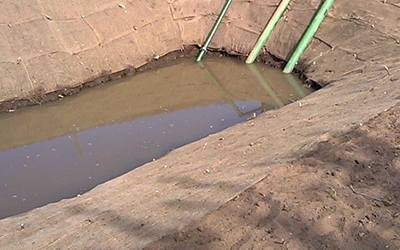
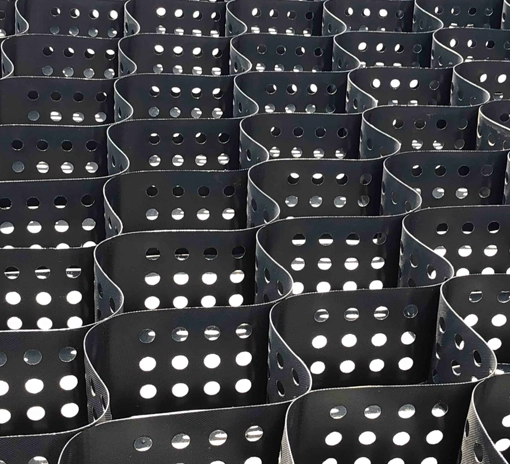
Greencell is a cellular confinement panel system that locks gravel, topsoil or concrete into a honeycomb structure, holding infill material in place under vehicle load rather than letting it shift or scatter.
Made from UV resistant polymer built for South African conditions, Greencell panels install with basic site preparation, no excavator or heavy compaction equipment required, which matters considerably on a rural property without contractor equipment on hand.
Once staked down and filled, the panels form a stable surface that keeps its shape for years, resisting both rutting from vehicle load and displacement from heavy rain, since the honeycomb cells prevent gravel from migrating sideways the way an unconfined surface always eventually does.
Findrains for Managing the Water Greencell Can't Stop on its Own
A stabilised surface still needs somewhere for water to go, and this is where fin drains, commonly called Findrains, do the work Greencell was never designed to handle.
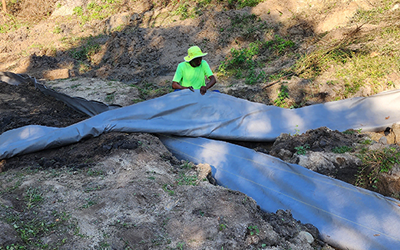
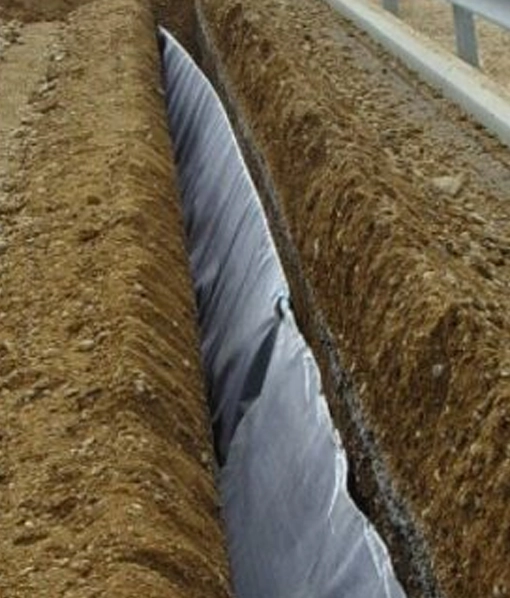
A Findrain is a prefabricated drainage composite, a thin core wrapped in geotextile fabric, installed along the edge of a driveway or road in a narrow trench to intercept and carry away subsurface water before it ever reaches the base layer.
This is important because water trapped under a driveway, rather than running off the surface, is what actually softens the ground and causes rutting to reappear even after a surface has been regraded.
A Findrain replaces the traditional French drain approach of filling a wide trench with imported stone, cutting both installation time and the volume of aggregate that needs hauling onto a rural site where access itself can be part of the challenge.
This is how the two work together on a single road or driveway:
|
Function |
Greencell |
Findrains |
|
Primary role |
Confines and stabilises surface infill |
Removes subsurface water |
|
Where it sits |
On the driveway or road surface |
Along the edge, below ground |
|
Installation |
No heavy machinery, staked and filled |
Narrow trench, prefabricated core |
|
Solves |
Rutting, gravel migration, surface load |
Waterlogging, softened subgrade |
|
Best paired with |
A working edge drainage system |
A confined, stabilised surface |
Used separately, each product solves part of the problem.
Used together, Greencell keeps the surface intact under load while Findrains keep water from undermining it from below, which is the combination that actually stops a rural driveway from needing the same repair every rainy season.
What to Check Before Starting a Driveway Stabilisation Project
A proper stabilisation plan starts with looking at where water currently pools on the property, since drainage always follows the lowest point regardless of where the driveway happens to run.
Farm owners should start by mapping the worst affected stretches first, typically the dips, low crossings or any section that has needed regrading more than once in the past year, and prioritising Findrain installation there before adding Greencell across the wider surface.
Getting the base compaction right before laying either product is as important as the products themselves, since even the best confinement system underperforms on a poorly prepared base.
We work with private landowners and farm properties across Mpumalanga on exactly this kind of civil and geosynthetic project, matching product specification to the specific soil, slope and rainfall pattern of each site instead of applying a single standard fix everywhere.
A driveway that handles a Lowveld storm without turning into a mud bath is not asking too much of a farm road.
It just needs the right system doing the right job, both above the surface and below it.
Frequently Asked Questions
What is Greencell used for on a farm driveway?
Greencell is a cellular confinement panel system that locks gravel, soil or concrete in place under vehicle load, preventing the rutting and gravel migration common on unpaved farm roads.
What is a Findrain and how does it help rural roads?
A Findrain is a prefabricated drainage composite installed in a narrow trench to carry away subsurface water, preventing the waterlogged base that causes driveway surfaces to soften and rut.
Do Greencell and Findrains need to be installed together?
Greencell and Findrains solve different problems and work best together, with Greencell stabilising the surface while Findrains manage the subsurface water that would otherwise undermine it.
Can Greencell be installed without heavy machinery?
Greencell panels install with basic site preparation and no excavator or heavy compaction equipment required, making them practical for rural properties without contractor equipment on site.
Why do gravel driveways rut faster on farms than in suburban areas?
Farm driveways carry heavier, less predictable loads from tractors, trailers and delivery vehicles, which shifts loose gravel sideways faster than typical suburban traffic and accelerates rutting after rain.